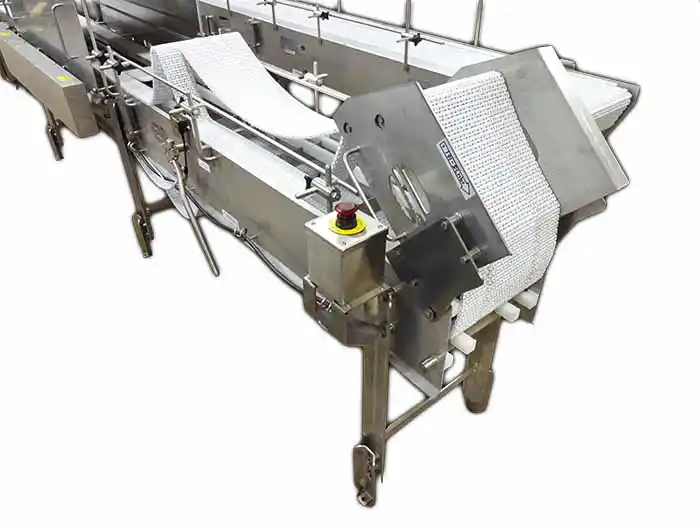
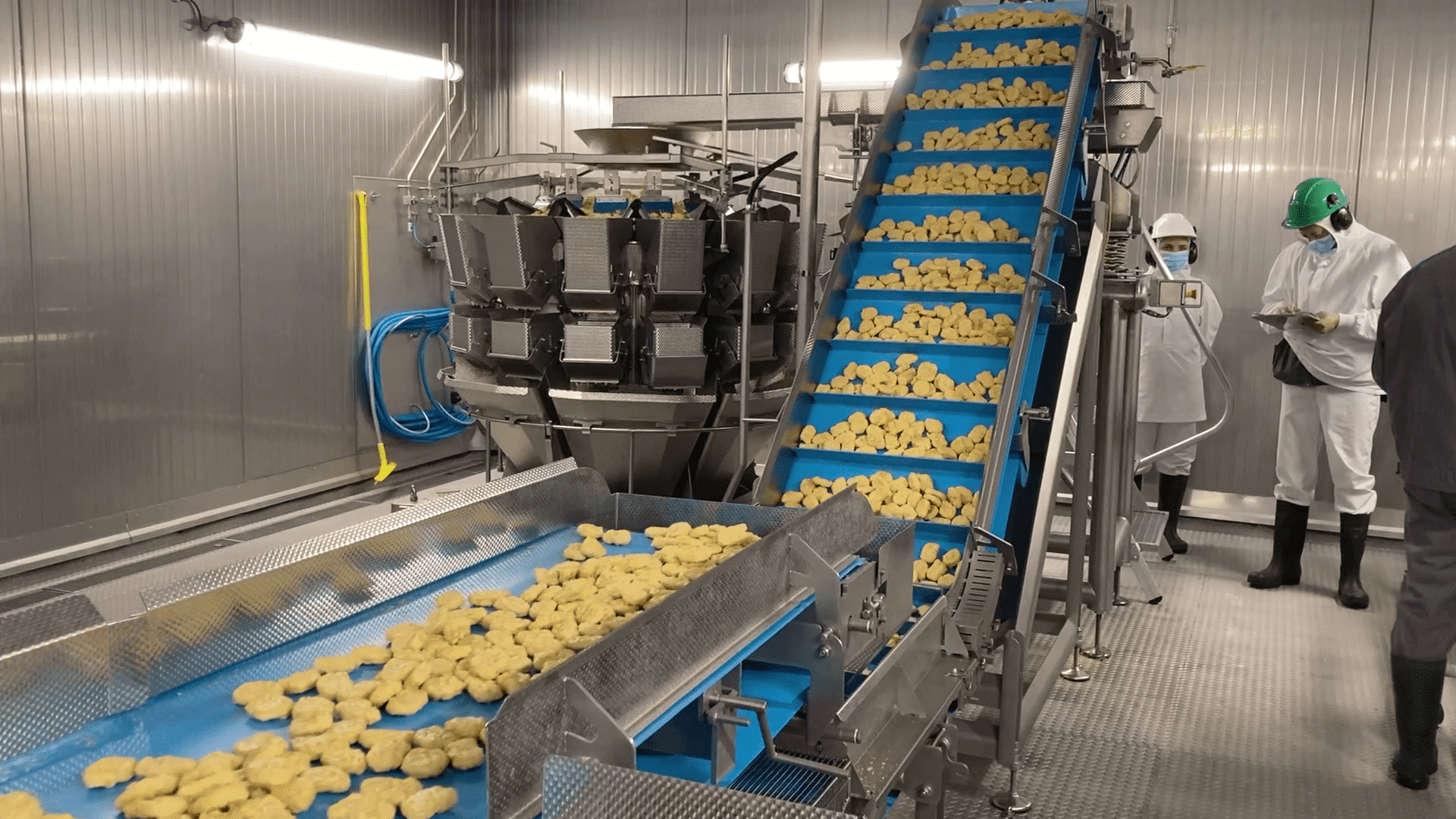
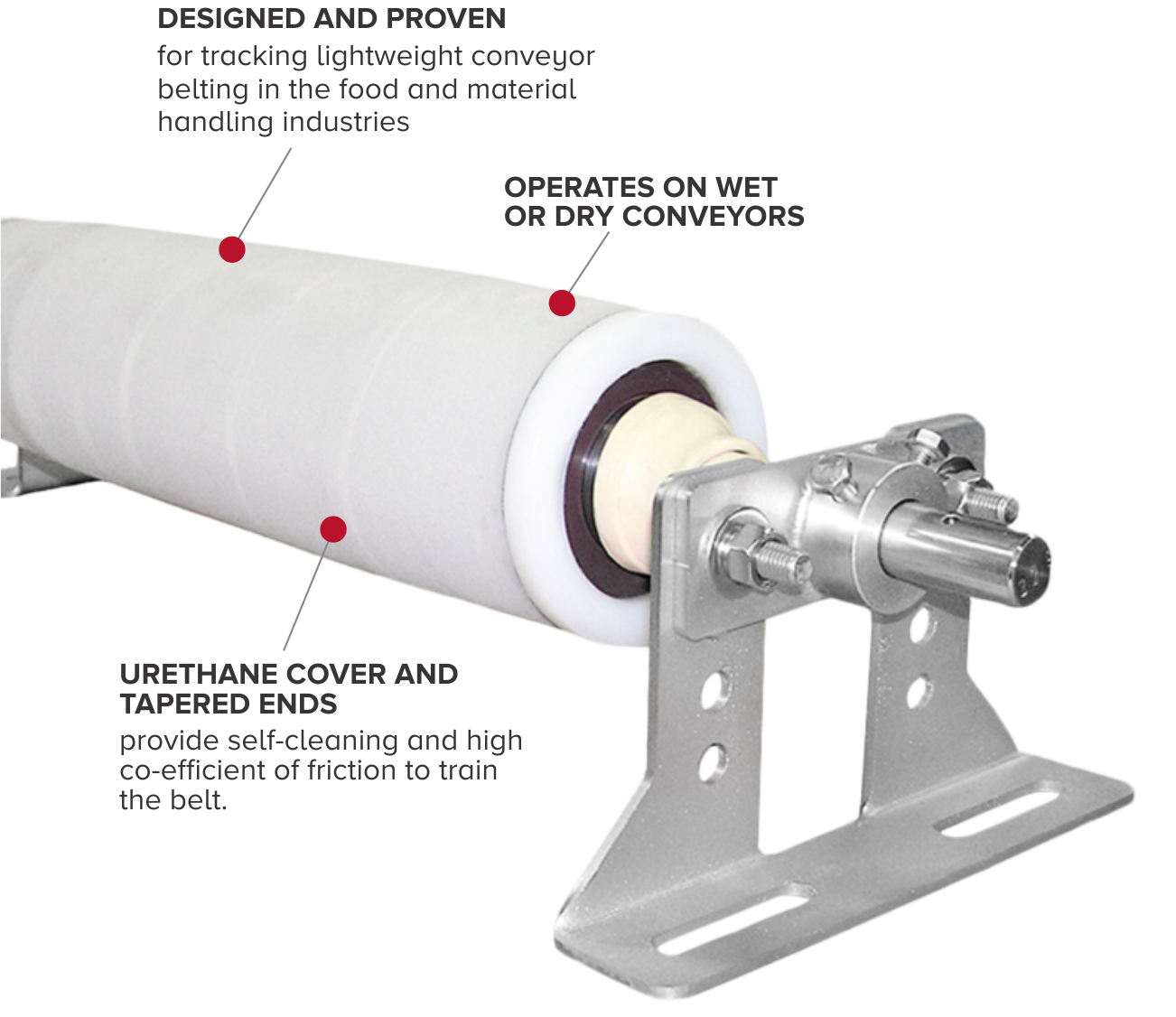
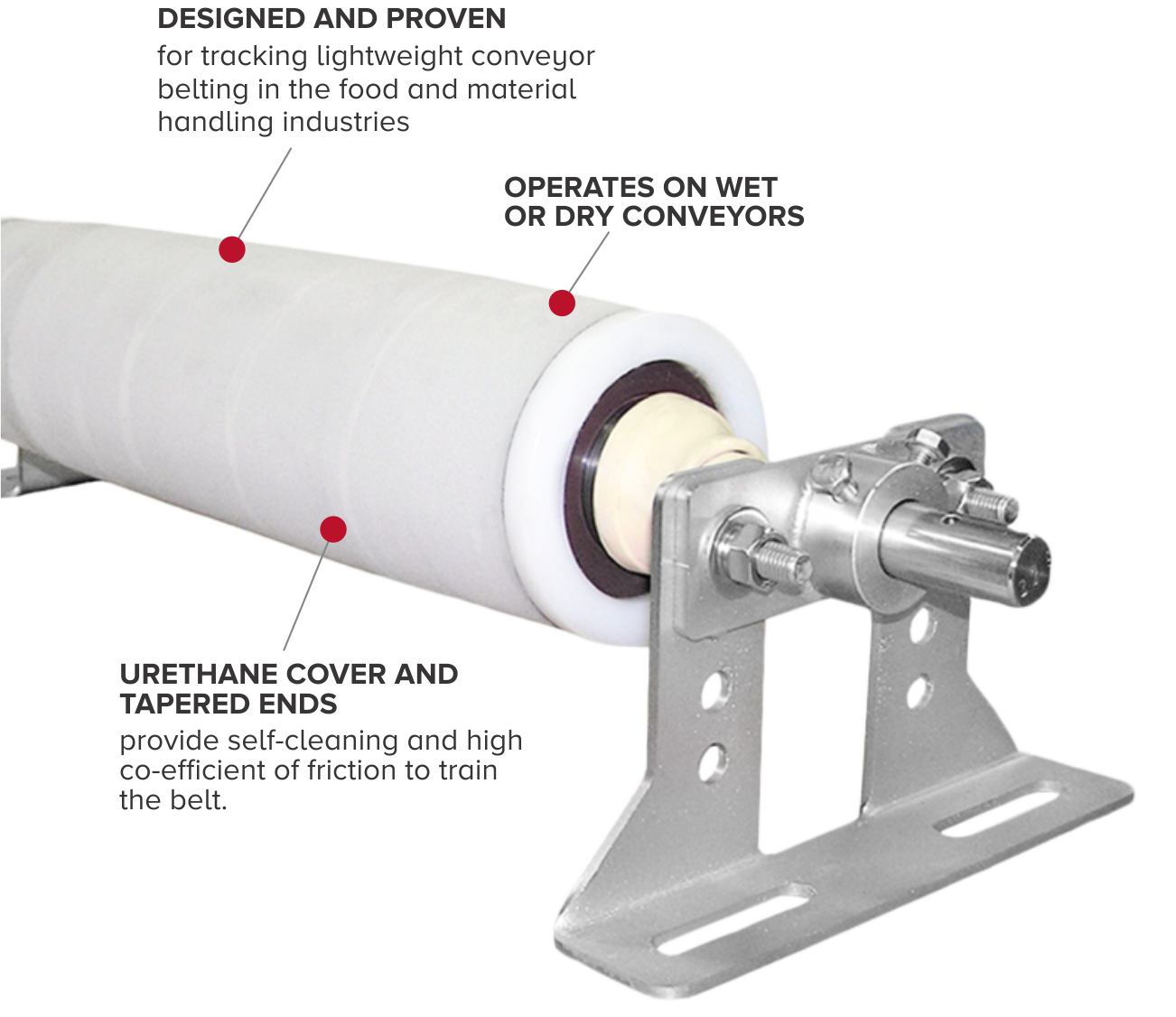
A food conveyor belt tracking system should be selected only after the conveyor frame, pulleys, belt, and loading conditions have been evaluated. Tracking hardware can correct normal running variation, but it cannot reliably compensate for a twisted frame, out-of-square pulleys, uneven loading, contaminated rollers, or a damaged belt splice.
For most straight, short food conveyors, correct pulley alignment, suitable belt tension, and either crowned pulleys or V-guided belting are usually the starting point. Edge guides and automatic tracking devices are better reserved for applications with persistent side forces, longer runs, demanding transfers, or repeated drift that remains after the conveyor itself has been corrected. In washdown areas, cleanability and access are selection requirements, not afterthoughts.
Start by separating tracking from tensioning
Tracking keeps a belt centered on the conveyor. Tensioning supplies the force needed for the belt to engage the drive, remain stable, and respond predictably to tracking adjustments. They are related, but they solve different problems.
A belt that is too loose may slip at the drive or wander unpredictably. A belt that is too tight can overload bearings, shafts, and belt splices, while making a lightweight food belt less forgiving. Increasing tension to stop edge drift is therefore usually an improvised fix rather than a tracking strategy.
Specify the belt tension range from the belt manufacturer, then design the take-up or tensioning arrangement so operators can set and maintain that range. For sanitary conveyors, the tensioning mechanism should be accessible for inspection and cleaning without creating difficult-to-reach debris traps.
Correct the conveyor before adding a tracker
A belt naturally reacts to the path presented by rollers and pulleys. A useful training principle is that the belt tends to move toward the end of a roller or idler that it contacts first, as described in this belt tracking guidance. That is why small angular errors at a pulley can produce a visible belt walk over time.
Before choosing conveyor belt tracking hardware, verify these fundamentals:
- The conveyor frame is level, square, and not twisted.
- Drive, tail, and snub pulleys are parallel and correctly aligned to the frame.
- Rollers turn freely and are not bent, worn, or carrying product buildup.
- The belt splice is straight and compatible with the belt construction.
- Product enters near the belt centerline rather than repeatedly pushing one side.
- Transfers, guides, and side rails do not rub the belt edge or impose constant side load.
- Belt tension is even across the width and within the belt supplier’s recommended operating range.
Installation errors, environmental changes, residue, and long or high-speed conveyor geometry can all contribute to mistracking. The underlying point is important: if the drift begins at the same location on every revolution, inspect the belt, splice, pulley surface, and local frame geometry before specifying a more aggressive tracking device.
Compare the main food conveyor belt tracking options
| Method | How it controls belt position | Best fit | Main limitations |
|---|---|---|---|
| Crowned pulley | The pulley profile encourages the belt toward its center | Straight, light-to-moderate duty conveyors using suitable flexible belts | Does not correct structural misalignment; may not suit every belt construction or pulley design |
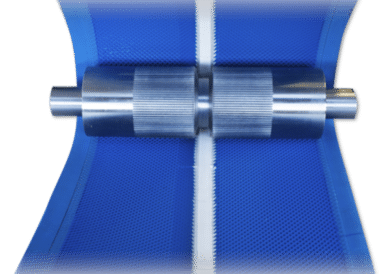
| V-guided belt | A V-profile on the belt underside runs in grooves in pulleys and support surfaces | Short-to-medium straight conveyors where positive lateral location is needed | Grooves and guides require sanitation access; guide bond quality matters |
| Adjustable end rollers | Small, controlled roller adjustments steer the belt | Basic tracking correction on conveyors with stable operating conditions | Requires disciplined adjustment and does not address root-cause alignment faults |
| Self-aligning idler or steering roller | The roller responds to belt movement and steers it back | Longer conveyors or applications with varying operating conditions | Must be designed for the belt, load, and sanitation environment; adds moving hardware |
| Edge guides | Physical rails limit lateral belt travel or product movement | Product containment and light incidental belt restraint | Constant belt-edge contact causes wear and can mask an alignment problem |
| Automatic tracker | Sensors or mechanical steering continuously correct belt position | Recurring drift, long runs, critical uptime, or variable side loading | Higher complexity; requires access for cleaning, service, and adjustment |
Source: qcconveyors
When crowned pulleys are the practical choice
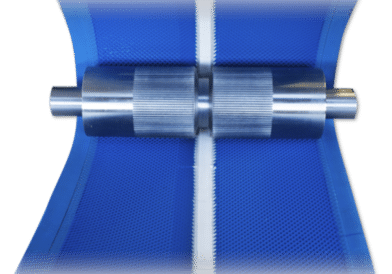
A crowned pulley has a slightly larger diameter at its center than at its edges. With compatible flat belts, this profile helps the belt seek the pulley center. Crowned pulleys are a straightforward option for dry or relatively clean straight conveyors where the belt is flexible enough to conform to the crown and where normal tracking adjustments are accessible.
They are not a substitute for correct alignment. A crowned pulley may reduce minor wander, but it will not make a badly skewed conveyor run correctly. It is also necessary to confirm compatibility with the belt supplier, particularly for modular belts, thick belts, belts with special underside profiles, and applications requiring a particular pulley geometry.
Choose crowned pulleys when the conveyor is mechanically sound, product loading is centered, and the goal is simple passive tracking rather than positive restraint.
When V-guided belting is a better fit
V-guided belting uses a continuous V-shaped profile bonded to the underside of the belt. The profile runs in matching grooves in the end rollers and, depending on the design, in the slider bed or support components. This creates positive lateral location across the belt width.
V-guides are often appropriate for narrow belts, conveyors with frequent indexing, applications with side loading at transfers, or installations where a belt must remain accurately located for product handling. As Dorner’s overview of V-guided and crowned belt tracking notes, the guide bond and the grooved pulley arrangement are central to the system’s performance.
For food processing, assess the sanitation consequences carefully. Grooves, belt underside features, and guide-support interfaces can collect water or residues if the conveyor is not designed for access and drainage. Specify materials suitable for the environment, open access to the grooves, and a cleaning method that reaches the belt return path and associated rollers.
Use edge guides carefully
Conveyor belt edge guides are often confused with tracking devices. Product side rails and belt-edge containment can keep packages, trays, or loose product in position, but they should not normally be used to force a wandering belt back to center.
If a moving belt continuously rubs a fixed edge guide, expect belt-edge wear, particles, noise, and eventual damage. In a food plant, rubbing contact can also create areas that are harder to inspect and clean. Use edge guides primarily for product control or as a limited-travel safeguard. If they are repeatedly contacting the belt, identify why the belt is drifting.
When to specify self-aligning or automatic tracking
Self-aligning idlers, steering rollers, and automatic trackers are appropriate when passive measures are not enough. They can be useful on longer conveyors, higher-speed lines, conveyors subject to variable loading, and applications where edge damage or unplanned stops have a disproportionate production cost.
A self-aligning device typically pivots or steers in response to belt movement. Automatic systems may use a mechanical sensing arrangement or a sensor-driven actuator to maintain belt position continuously. These systems should be selected as part of the conveyor design, not bolted on without reviewing available straight run, belt construction, return-path clearance, and service access.
In sanitary service, ask these questions:
- Can the tracker be reached during cleaning and inspection?
- Are pivots, rollers, seals, and sensor housings compatible with the washdown environment?
- Will the device create horizontal ledges, enclosed cavities, or trapped moisture zones?
- Can operators observe belt position without reaching into a moving conveyor?
- Is the adjustment method documented so routine corrections do not become trial-and-error maintenance?
Source: asgco
Match the system to the operating environment
Dry packaged-food lines
For cartons, wrapped products, pouches, or trays on a dry line, crowned pulleys or V-guided belts are often sufficient when the conveyor is square and loading is centered. Consider automatic tracking if line speed, long center distances, frequent product accumulation, or repeated side transfers create variable lateral forces.
Wet and washdown processing areas
Wet environments introduce water, product residues, changing friction, and more frequent cleaning. Prioritize open construction, drainage, corrosion-resistant materials, accessible return rollers, and hardware that can be cleaned without disassembly beyond the plant’s normal sanitation procedure. Avoid adding hidden guide channels or complex tracker assemblies unless their tracking benefit justifies the sanitation burden.
Sticky, loose, or residue-forming products
Buildup on a roller changes its effective diameter and can steer the belt. In these applications, cleaning access and roller selection may matter more than a more elaborate tracking device. Locate scraper, cleaning, or inspection provisions where buildup begins, and determine whether the belt underside or guide grooves can retain product.
Side-loading and transfer-intensive conveyors
A product pushed onto a belt from one side, discharged by a fixed device, or accumulated against a rail can impose lateral force. First reduce the force through transfer design, guide-rail adjustment, and centered loading. Then consider V-guiding or an automatic steering device if the side load is inherent to the process.
Warning signs that indicate a larger alignment problem
Do not treat the following symptoms as ordinary belt tracking issues:
- The belt consistently runs to one side immediately after every adjustment.
- Drift changes when a particular belt splice reaches a pulley.
- One belt edge is visibly more worn than the other.
- A roller is hot, noisy, difficult to turn, or visibly contaminated.
- The conveyor frame has been struck, relocated, modified, or exposed to uneven support.
- The belt tracks acceptably empty but moves sharply under product load.
- Operators have added shims, tightened one side excessively, or relied on a fixed rail to contain the belt.
These signs point toward belt damage, pulley misalignment, uneven tension, structural distortion, loading problems, or buildup. Adding edge guides or repeatedly changing tension may hide the symptom while increasing wear.
Food conveyor belt tracking system specification checklist
Use this checklist when requesting a conveyor or retrofit proposal:
- Belt type: Flat belt, modular belt, fabric-reinforced belt, plastic belt, or specialty belt; include belt width, splice type, and underside profile.
- Conveyor geometry: Center distance, width, incline or decline, curves, transfers, accumulation zones, and available straight run.
- Load conditions: Product weight, distribution, loading point, side transfers, indexing, accumulation, and maximum expected side force.
- Operating environment: Dry, damp, wet, washdown, temperature variation, residue type, and exposure to cleaning methods used in the plant.
- Tracking method: Crowned pulley, V-guide, manually adjustable roller, self-aligning roller, edge restraint, or automatic steering.
- Tensioning method: Take-up type, adjustment range, access, repeatability, and belt manufacturer’s tension requirement.
- Sanitary design: Cleanability of grooves, rollers, return path, pivot points, and sensor brackets; drainage and access for inspection.
- Maintenance plan: Inspection frequency, spare parts, adjustment procedure, ownership of alignment checks, and criteria for replacing worn belts or rollers.
The best food conveyor belt tracking system is usually the simplest arrangement that remains stable under actual loading and cleaning conditions. Start with a correctly built and aligned conveyor, use tension within the belt supplier’s guidance, and add positive or automatic tracking only where the application genuinely requires it.
References
- Common Conveyor Belt Tracking Problems. (n.d.). https://fmhconveyors.com/blog/conveyor-belt-tracking-problems
- Conveyor Belt Tracking / Training. (n.d.). https://www.radialstackers.com/support/tracking-training
- Belt Tracking Systems - Martin® Tracker™. (n.d.). https://www.martin-eng.com/content/product/171/tracker
- Hygienic Belt Conveyor Design Guidelines | PDF. (n.d.). https://www.scribd.com/document/681565720/Hygienic-Design-of-Belt-Conveyors-for-the-Food-Industry
- How to Effectively Track a Conveyor Belt: Tips and Solutions. (n.d.). https://mltgroup-conveyor.com/news/how-to-track-a-conveyor-belt
- Food Conveyor & Material Handling Maintenance Guide. (n.d.). https://oxmaint.com/industries/food-manufacturing/conveyor-material-handling-maintenance-food-plants-hygiene
- Belt Conveyor Tracking V-Guided vs Crowned Roller - Dorner Conveyors. (n.d.). https://www.dornerconveyors.com/resource/belt-conveyor-tracking-v-guided-vs-crowned-roller
- The Importance of Properly Installed Conveyor Belts and Addressing …. (n.d.). https://miconveyancesolutions.com/the-importance-of-properly-installed-conveyor-belts-and-addressing-belt-tracking-problems