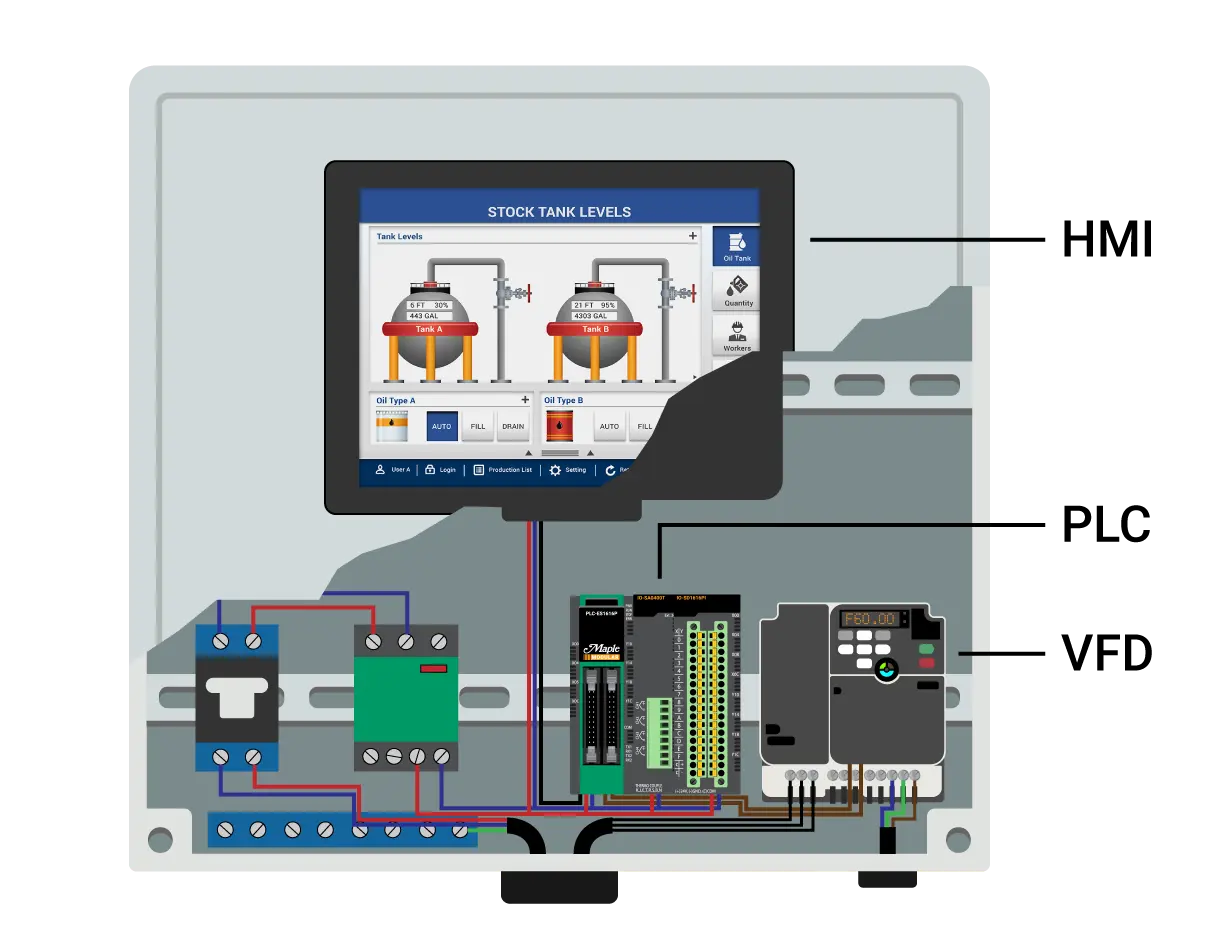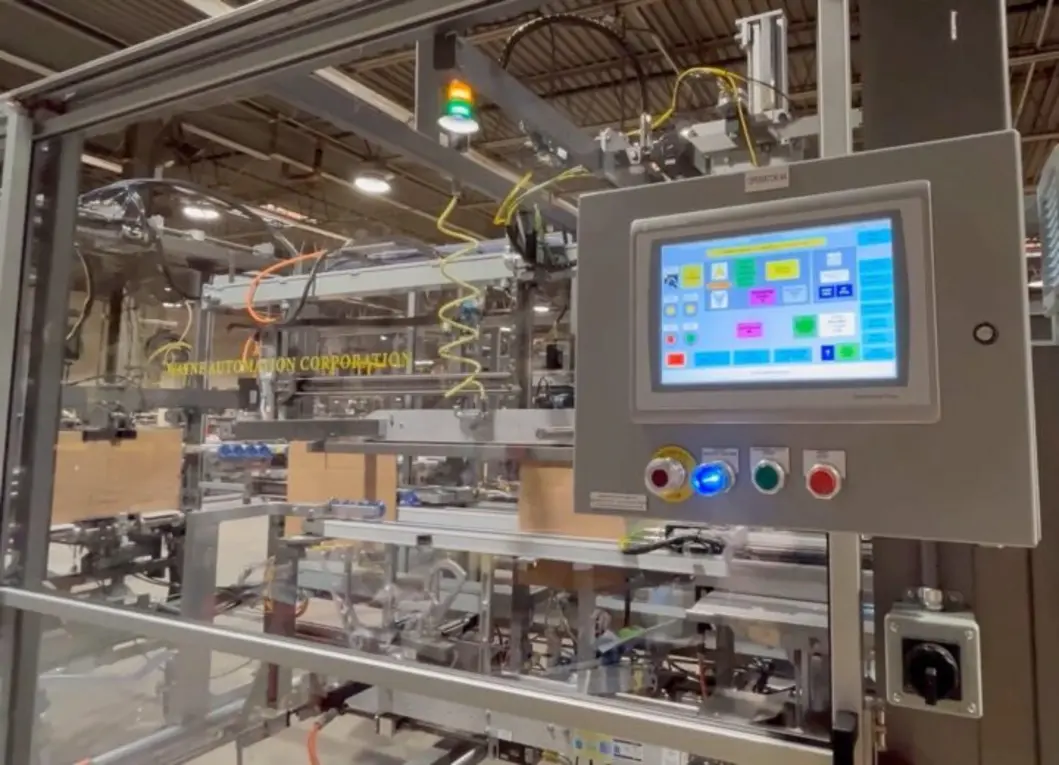
For a small, self-contained machine network, an unmanaged industrial Ethernet switch can be the right choice. If a packaging machine has a PLC, HMI, and a few fixed devices on an isolated network, and a short outage caused by a cable failure is acceptable, simple plug-and-play switching may be all that is needed.
A managed vs unmanaged Ethernet switch for packaging line decision changes once the network carries multiple PLCs, remote I/O, VFDs, vision systems, production data, or connections to plant systems. Managed switches do not make a line faster by themselves. They provide visibility and control: the ability to identify a bad port, manage multicast traffic, separate network zones, support resilient topologies, and apply a defined configuration as the line evolves.
Start with the network role, not the port count
The number of connected devices matters, but it is not the only selection criterion. A six-device network with remote access, EtherNet/IP I/O traffic, a vision camera, and a plant connection can need managed hardware more than a ten-device isolated machine cell.
A useful first question is: What happens if communication becomes slow, unstable, or unavailable? If maintenance can locate the fault at the cabinet and restore a simple machine quickly, an unmanaged switch may be adequate. If the interruption stops a multi-machine line, affects traceability, leaves a maintenance team without diagnostics, or creates a difficult-to-find intermittent fault, managed switching is usually justified.
Managed and unmanaged switches compared
| Consideration | Unmanaged industrial switch | Managed industrial switch |
|---|---|---|
| Basic Ethernet forwarding | Yes | Yes |
| Setup | Plug-and-play | Requires initial configuration and documentation |
| Port status and traffic visibility | Limited | Detailed port status, event information, and monitoring options |
| VLAN segmentation | No | Usually available |
| Multicast management | No configuration control | Can support features such as IGMP snooping where required |
| Port mirroring for troubleshooting | No | Usually available |
| Network redundancy support | Generally no | May support ring and other resilient topologies |
| Security and access controls | Limited | Can provide management access controls and network policy features |
| Best fit | Small, isolated, stable machine networks | Connected, critical, growing, or diagnostically demanding line networks |
The distinction is not that managed switches are inherently more reliable electronic devices. The practical difference is that a managed switch gives the team tools to see and shape network behavior. Those tools are valuable only when they are properly selected, configured, backed up, and maintained.
When an unmanaged industrial switch is adequate
An unmanaged switch is often a sensible specification for a bounded machine network with few devices and little expected change. Typical examples include a compact conveyor section, a standalone packaging station, or an OEM-built machine with a fixed PLC, local HMI, and a small number of drives or I/O devices.
An unmanaged switch is a reasonable choice when all or nearly all of the following are true:
- The network is isolated from the plant backbone and business network.
- Device count is low and unlikely to grow.
- The machine has no special multicast-management requirement.
- No VLANs are needed to separate controls, vision, remote service, or other traffic.
- A single network path is acceptable; there is no requirement for cable-fault recovery through a ring.
- Maintenance can access the machine locally and troubleshoot with basic tools.
- The switch is industrially suitable for the enclosure and operating environment.
Simple does have advantages. There is no switch configuration to create, secure, document, or restore. For repeatable OEM machinery, that can reduce commissioning effort and eliminate configuration inconsistency between machines.
However, “unmanaged” should not mean “unspecified.” The switch still needs the correct port count, electrical supply arrangement, mounting method, environmental rating, connector type, and industrial temperature and vibration suitability for its location.
When a managed switch is the better choice
Specify a managed industrial Ethernet switch when the packaging line needs controlled growth, fault visibility, traffic management, or separation between connected systems.
A managed switch is usually warranted when the line includes several of these conditions:
- Multiple PLC panels, packaging machines, or conveyor zones are connected together.
- Remote I/O, VFDs, servo systems, safety-related network components, or intelligent field devices are distributed across the line.
- A vision inspection system, barcode reader, printer, historian, SCADA connection, or remote-support connection shares the network.
- The control network connects to a plant backbone, manufacturing execution system, or another external network zone.
- The automation protocol uses multicast traffic that must be controlled appropriately.
- The line needs rapid diagnosis of intermittent communication faults.
- A cable break must not necessarily take down all downstream equipment.
- The plant requires network segmentation or controlled device access.
- The line may expand through future equipment additions.
What managed-switch functions actually solve
Managed-switch feature lists can be long. For packaging engineers, the important issue is the production problem each feature addresses.
Port diagnostics and monitoring help identify whether a device is connected, whether a link is repeatedly dropping, and which port is carrying unexpected traffic. This can shorten packaging line network troubleshooting when a fault could otherwise be mistaken for a PLC, drive, cable, or device problem.
Port mirroring copies traffic from one port or network segment to another port for analysis. It can help a qualified controls or network technician observe a device conversation without disconnecting production equipment or inserting an improvised connection.
VLANs create logical network separation on shared switching infrastructure. For example, a plant may separate machine controls traffic from a remote-access connection or from noncritical data collection. VLANs are useful only as part of an overall network design; they are not a substitute for a properly designed cybersecurity boundary.
IGMP snooping is relevant on networks that use multicast traffic, including many EtherNet/IP applications. Without appropriate multicast handling, multicast messages can be forwarded broadly across a network segment, increasing unnecessary traffic. Whether it is needed depends on the automation architecture and protocol behavior, so it should be confirmed during design rather than enabled by assumption.
Quality of service (QoS) can prioritize selected traffic where the switch and automation design support it. It may be useful on mixed-use networks, but it is not a cure for an overloaded, poorly segmented, or incorrectly designed control network.
Redundancy functions can support ring or alternate-path topologies. These functions are appropriate when a single cable failure would create unacceptable downtime and when all participating equipment and protocols are designed for the selected topology.
Source: media.maplesystems
Food plant environment: select the hardware separately from the management level
Managed versus unmanaged is only one part of the specification. Food packaging areas may expose electrical equipment to washdown, humidity, temperature variation, vibration, dust, and cleaning activity. A switch that is appropriate inside a protected, conditioned control panel may not be appropriate near a wet processing or washdown area.
For each installation location, verify:
- Enclosure placement and the environmental protection needed for that location.
- Temperature range, condensation risk, vibration, and electrical-noise conditions.
- Power-input requirements, grounding approach, and available power redundancy where needed.
- Copper versus fiber uplinks for distance, electrical isolation, or inter-building connections.
- Connector, cable, gland, and cabinet-entry details that preserve the enclosure design.
- Access for maintenance without opening equipment unnecessarily in production areas.
An industrial Ethernet switch for a food plant should be selected with the control-panel designer, maintenance team, IT or OT network owner, and sanitation requirements in mind. Do not assume a hardened industrial switch alone makes an installation suitable for a washdown location.
A practical selection framework
Use the following sequence when choosing line switching hardware.
1. Draw the actual network
List every endpoint: PLCs, remote I/O adapters, drives, HMIs, printers, scanners, cameras, wireless access points, engineering ports, gateways, and uplinks. Include devices planned for the next machine addition, not only the startup configuration.
Identify which devices exchange time-sensitive control traffic, which generate high-volume data, and which connect beyond the local line.
2. Define the boundary
Decide whether the switch is inside an isolated machine network, a line-level controls network, or a connection point between the line and plant systems. The closer a switch is to a network boundary, the stronger the case for managed visibility, segmentation, and access control.
3. Identify multicast and protocol requirements
Confirm the protocol and communication pattern for each device. Do not select based only on the brand of PLC or drive. Determine whether multicast control, protocol-aware functions, timing behavior, or vendor-specific topology requirements apply.
4. Set the downtime requirement
Ask whether a broken cable, failed uplink, or misconnected device can stop production. If recovery must be fast, specify monitoring and, where appropriate, a resilient topology rather than relying on maintenance to find a physical fault after the line stops.
5. Match features to maintenance capability
A managed switch needs an owner. Someone must set passwords, apply the approved configuration, retain a backup, control firmware changes, and interpret alarms or diagnostics. If that capability does not exist locally, use a simpler architecture or establish support responsibility before installing advanced hardware.
Common selection mistakes
The most common error is using an unmanaged switch because the initial machine layout appears small, while leaving no practical path for a plant connection, diagnostics, or expansion. The opposite error is specifying a feature-rich managed switch without a documented configuration or a team responsible for it.
Other frequent problems include:
- Using office-grade equipment in an unsuitable industrial location.
- Adding a vision system or remote-service device to an existing controls segment without reviewing traffic and security implications.
- Building a ring topology without confirming compatibility across all devices.
- Enabling features such as VLANs, QoS, or IGMP snooping without a documented purpose and validation plan.
- Treating a VLAN as the sole cybersecurity control.
- Leaving switch management interfaces reachable with default or weak access settings.
- Failing to label ports, cables, cabinets, and uplinks clearly.
Commissioning checks before startup
Before production startup, verify the network as a system rather than simply confirming that every device has a link light.
- Record the switch model, location, serial information, power source, port map, and approved configuration version.
- Confirm device IP addressing, subnetting, gateway settings, and naming conventions against the controls design.
- Check that each endpoint appears on the intended port and that unused ports are handled according to the site policy.
- Verify VLAN membership, uplink paths, multicast settings, and port settings where these are used.
- Test normal machine operation while all expected devices are communicating, including printers, vision systems, and production-data connections.
- Review switch events and port statistics for link flaps, errors, unexpected speed negotiation, or unusually busy links.
- Test the intended response to a cable or uplink failure only under an approved commissioning plan and with affected stakeholders aware.
- Save the final managed-switch configuration in the line documentation and retain a known-good backup.
The practical rule
Use an unmanaged switch for a genuinely small, isolated, stable machine network where simplicity is the main requirement. Use a managed switch when the packaging line must be observable, segmented, remotely supported, protected from uncontrolled multicast behavior, or designed to tolerate change and faults.
For most connected packaging lines, the cost question is not only the price of the switch. It is the cost of finding the next communication fault, integrating the next device, or recovering from an avoidable network interruption.
References
- Managed vs. Unmanaged Industrial Ethernet Switches. (n.d.). https://www.lakelandengineering.com/managed-vs-unmanaged-industrial-ethernet-switches-which-do-you-need
- Managed vs. Unmanaged Industrial Ethernet Switches: How to Choose. (n.d.). https://maisvch.com/blog/managed-vs-unmanaged-industrial-ethernet-switch
- Managed vs unmanaged switches : r/PLC. (n.d.). https://www.reddit.com/r/PLC/comments/1l3i7c7/managed_vs_unmanaged_switches
- Industrial Ethernet Switch: Managed vs Unmanaged Guide - Zbotic. (n.d.). https://zbotic.in/industrial-ethernet-switch-managed-vs-unmanaged-guide
- Industrial Ethernet Switches for Intelligent Transportation …. (n.d.). https://comnet.net/resources/blog/industrial-ethernet-switches-for-intelligent-transportation-systems-its-buyers-guide
- Managed vs Unmanaged - Which Ethernet Switch is Best for Industrial Environments? - KnowHow. (n.d.). https://knowhow.distrelec.com/automation/managed-vs-unmanaged-which-ethernet-switch-is-best-for-industrial-environments
- Designing Industrial Ethernet Networks for Plant PLC Integration. (n.d.). https://industrialmonitordirect.com/blogs/knowledgebase/designing-industrial-ethernet-networks-for-plant-plc-integration
- How to choose between managed and unmanaged switches. (n.d.). https://www.controleng.com/how-to-choose-between-managed-and-unmanaged-switches