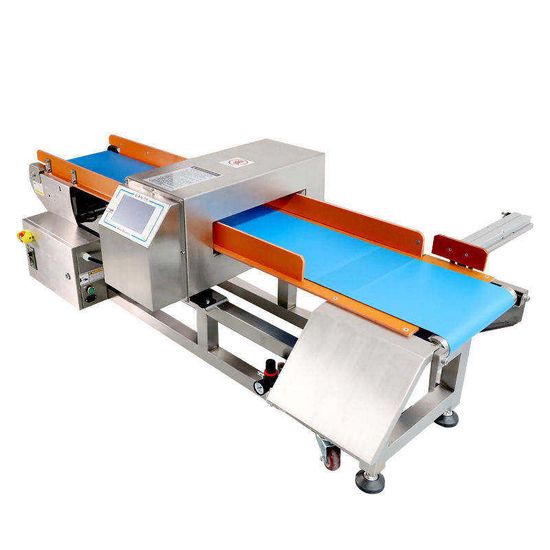
Repeated food metal detector false rejects should be treated as a food-safety and process-control event, not simply as a nuisance fault. The first job is to contain and identify potentially affected product according to the site food-safety plan. The second is to establish whether the detector found metal, whether the reject system acted correctly, or whether the equipment reacted to product effect, vibration, electrical noise, or an unstable setup.
Do not begin by reducing sensitivity, bypassing the reject device, or repeatedly resetting alarms. Those actions can obscure the cause and may weaken an established foreign-material control. A disciplined check of the reject path, test-piece performance, product settings, and line environment is a safer and faster way to restore reliable operation.
What counts as a false reject?
A false reject is a product rejected when subsequent controlled investigation finds no metal contamination and the trigger was caused by another signal or a system fault. It is important not to label every unexplained rejection as false immediately. A rejected pack can contain small or embedded metal that is not obvious during a visual examination.
The main cause categories are:
- Genuine contamination: metal is present and the detector responded as intended.
- Product effect: the electrical characteristics of the product create a detector response.
- Reject-system fault: the detector alarm, timing, actuator, confirmation device, or reject-bin control does not behave as expected.
- Mechanical disturbance: vibration, belt movement, product presentation, or nearby metal movement destabilizes the signal.
- Electrical or electromagnetic interference: variable-frequency drives, motors, cables, static, or other equipment affect the detector.
- Incorrect or outdated operating settings: the selected product program does not match the product, pack, line speed, or installation condition.
Wet, salty, high-moisture, and temperature-variable products are commonly more challenging because their conductivity can create a signal known as product effect. Product variation can matter as much as the nominal recipe: changes in temperature, fill weight, moisture, salt level, shape, spacing, or packaging can alter the signal seen by the detector.
Immediate response: contain, document, and preserve evidence
Follow the site’s written corrective-action procedure whenever detector performance is in doubt. The appropriate disposition of product depends on the hazard analysis, monitoring records, last confirmed acceptable check, product traceability, and site procedures.
At minimum, record:
- Time and duration of the events.
- Line, detector, and active product program.
- Product code, lot or batch identification, packaging format, and operating conditions.
- Alarm messages, reject counts, and any confirmation-sensor status.
- Recent changes to product, packaging, line speed, upstream equipment, maintenance, cleaning, or utilities.
- The results of verification checks and the identity of the person completing them.
Avoid clearing event logs until relevant information has been captured. A pattern in timing is often diagnostic: one reject every few minutes may indicate a recurring disturbance, while rejects that occur only during a product transition may point toward product setup or presentation.
Step 1: Verify the complete reject system before investigating sensitivity
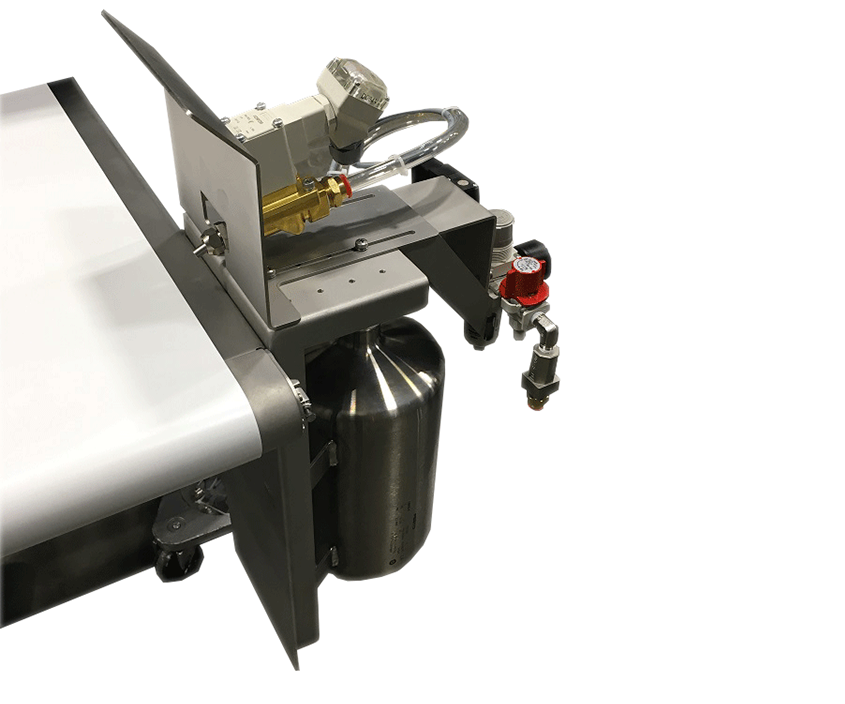
A metal detector is only an effective control if it detects the challenge and the affected unit is positively removed or otherwise managed according to the designed system. Start with the entire sequence, not the detector head alone.
Source: assets.eaglepi
Check the reject path
Using the approved site procedure and authorized test pieces, confirm that the system can:
- Detect the specified test piece in the intended product and package condition.
- Trigger the reject device at the correct time.
- Remove the correct pack, container, or product portion.
- Confirm the rejected item where a reject confirmation device is installed.
- Detect a full reject container, blocked chute, or other reject-bin condition where those controls are fitted.
- Prevent or manage product flow when the reject system is not available, as defined by the site design and procedure.
A detector may alarm correctly while the pneumatic pusher, air blast, retracting belt, diverter, flap, or drop mechanism misses the target because of timing drift, low air supply, product spacing changes, belt-speed changes, worn components, or a blocked reject route.
Also inspect whether good product is being swept into the reject area. A too-long reject pulse, unstable product spacing, poor guide-rail setup, or a late sensor signal can make a correctly triggered reject appear to be a false detection event.
Check sensors and counters
Photoelectric sensors and encoder signals are central to reject timing on many conveyor systems. Check for dirty lenses, loose brackets, damaged cables, incorrect sensor alignment, or product presentations that do not reliably break the sensor beam. Compare detector event counts, reject counts, and reject-confirmation counts where the controls provide these records.
A count mismatch is not proof of a particular failure, but it is a reason to stop treating the issue as a simple false-reject problem. Escalate it through the site’s food-safety and maintenance process.
Step 2: Confirm test-piece checks and the active product program
Test pieces verify performance only when they are correct for the application and passed through in the approved manner. Use only the certified or controlled test standards specified by the site program. Do not substitute improvised metal objects.
Review the following before changing any settings:
| Check | Why it matters | What to investigate if it fails or varies |
|---|---|---|
| Active product program | Programs may contain product-effect compensation and sensitivity settings | Wrong recipe selection, unauthorized parameter changes, incomplete changeover |
| Test-piece placement | Detection performance can vary through the aperture and package | Whether checks follow the approved path, position, and product condition |
| Product presentation | Orientation, spacing, height, and belt position affect stability and rejection timing | Guides, belt tracking, product buildup, inconsistent pack placement |
| Product and pack condition | Product effect can change with formulation, temperature, fill, and packaging | Recent ingredient, pack, seal, weight, or process changes |
| Detector records | Alarm patterns help distinguish random noise from repeatable conditions | Time-correlated events, warning messages, repeated signals at one operating condition |
A passed test piece does not automatically prove that every random reject is harmless. Conversely, random false rejects do not necessarily mean the detector is too sensitive. The correct question is whether the system consistently meets its validated detection and rejection performance under normal production conditions.
Step 3: Determine whether product effect is involved
Product effect occurs when the product itself disturbs the detector’s electromagnetic field. It is most often associated with conductive products, including those with substantial moisture or salt, but product geometry and temperature variation can also affect the response.
Look for a repeatable pattern:
- Rejects occur only with one product, package size, or recipe.
- The detector is stable with an empty belt or a dry reference product but unstable with the production product.
- Rejects begin after a temperature shift, formulation change, thawing behavior change, or fill-weight drift.
- The problem is worse at the beginning or end of a run, during changeovers, or when product spacing changes.
If product effect is likely, compare current conditions with the conditions under which the program was established. Confirm that the product program is correct and that the product is within the operating range assumed during validation.
Modern systems may offer product-effect compensation, phase adjustment, multiple frequencies, or auto-setup functions. These are not generic cure-all controls. Any adjustment that affects metal detector sensitivity or discrimination should be made only by trained, authorized personnel and then verified through the site’s documented validation or revalidation process.
Step 4: Inspect mechanical causes of unstable signals
Mechanical movement around the aperture can generate unstable readings. Inspect the detector and conveyor while the line is running, following applicable lockout and guarding procedures before touching equipment.
Check for:
- Loose detector head mounts, conveyor supports, guards, rails, or framework.
- Excessive vibration from motors, drives, conveyors, pumps, or upstream machines.
- A belt that tracks inconsistently, rubs the structure, or has damaged joints.
- Metal fragments, tools, fasteners, or buildup near the detector aperture.
- Product striking guides, clustering, tipping, or passing through at varying positions.
- Moving metal parts close to the detector, including reject hardware or access doors.
A useful diagnostic distinction is repeatability. A false signal that appears at the same belt position or with a particular pack orientation suggests a physical or product-presentation issue. A random signal with no product correlation may point more strongly to vibration, electrical interference, or an intermittent component fault.
Step 5: Investigate electrical interference and installation conditions
Electrical interference can resemble a detection event. Review what changed when the issue started: maintenance work, a new motor drive, welding activity, altered cable routing, changes to adjacent equipment, or an intermittent utility problem.
Qualified maintenance or the equipment supplier should assess items such as grounding, shielding, cable condition, power quality, motor-drive noise, and separation from sources of electromagnetic disturbance. Do not alter electrical connections or safety circuits as an informal production-line experiment.
Where possible, compare behavior during controlled operating states: empty conveyor, conveyor running without product, product present with nearby equipment stopped, and normal production. These comparisons should be planned so that food-safety controls and guarding remain intact. They can help isolate whether the trigger follows the product, the conveyor, or another machine.
A practical troubleshooting sequence
Use this order to avoid masking the issue:
- Contain and identify product in line with the site corrective-action plan.
- Capture evidence from alarms, counts, settings, and recent change records.
- Verify detector and reject-system operation with approved checks.
- Confirm the active product program and approved test-piece method.
- Check product and packaging variation against validated operating conditions.
- Inspect mechanical stability and product presentation.
- Investigate electrical and environmental interference with qualified personnel.
- Make controlled, authorized adjustments only when justified.
- Document verification or revalidation before releasing the line back to routine operation.
When to stop and escalate
Stop routine production and escalate through the site’s food-safety, quality, and maintenance procedures when any of the following occurs:
- An approved test piece is not detected or is detected but not reliably rejected.
- The reject confirmation device, reject-bin control, or associated fail-safe function does not operate as intended.
- Detector settings have changed without authorization or cannot be confirmed.
- The detector is unstable across products or during an empty-belt condition.
- There is evidence of electrical damage, damaged guarding, loose structural parts, air-system problems, or repeated unexplained alarms.
- A product, formula, packaging, or process change may place production outside the established validation.
The equipment manufacturer or a qualified service provider may be needed for calibration, repair, software configuration, or a formal performance review. Food-safety personnel should determine whether product holds, inspection, rework, or disposal are required under the plant’s documented program.
Preventing repeat false rejects
The best prevention is controlled change management. Maintain a clear link between each product program and its validated product, package, line speed, and test procedure. Record changes to formulation, ingredients, moisture behavior, pack format, upstream equipment, and conveyor configuration before they become unexplained reject events.
Routine maintenance should include conveyor condition, detector mounting, cables, sensors, pneumatic components, reject mechanisms, and reject-bin devices. Operators also need a clear escalation path: a recurring reject pattern is useful process information, not an alarm to silence.
Reducing false rejects matters because it reduces unnecessary waste and disruption. Maintaining proven metal detector sensitivity and a verified reject system matters because the control is there to protect product. A troubleshooting process that addresses both goals is more reliable than adjusting sensitivity in response to pressure from the line.
References
- Reduce False Rejects in Food Metal Detection Systems. (n.d.). https://jindunelec.com/blog/reduce-false-rejects-food-metal-detection
- Understanding False Rejects in Metal Detectors. (n.d.). https://www.foodmanvision.com/understanding-false-rejects-in-metal-detectors-and-how-to-minimize-them
- Food Metal Detection Challenges Every Manufacturer Should …. (n.d.). https://www.andinspection.com.au/common-food-metal-detector-challenges-and-how-to-overcome-them
- How to Reduce False Rejects in Food Metal Detector Systems. (n.d.). https://www.vixdetect.net/how-to-reduce-false-rejects-in-food-metal-detector-systems.html
- Reducing metal detection false rejects caused by product effect | ProFood World. (n.d.). https://www.profoodworld.com/leaders-new/business-drivers/food-safety/article/13275656/reducing-metal-detection-false-rejects-caused-by-product-effect
- Metal Detection in Food Packaging | What You Should Know. (n.d.). https://www.alleratech.com/blog/metal-detection-in-food-packaging
- How to validate a metal detector for food safety | Pragash Ramadoss posted on the topic | LinkedIn. (n.d.). https://www.linkedin.com/posts/pragashramadoss_metal-detector-validation-template-activity-7318815909089820672--icu
- Troubleshooting False Alarms | Metal Detector for Food Industry. (n.d.). https://www.kenweigroup.com/article/troubleshooting-false-alarms-metal-detector-food.html